Key Research
A significant body of research has been conducted on bremelanotide, particularly in the context of female sexual dysfunction. The RECONNECT studies, two phase 3 clinical trials, are among the most pivotal.
In these studies, premenopausal women with hypoactive sexual desire disorder (HSDD) were treated with either bremelanotide or a placebo. The results, published in Obstetrics & Gynecology, showed that women who received bremelanotide experienced statistically significant improvements in sexual desire and a reduction in the distress associated with low desire Kingsberg et al., 2019. A subsequent open-label extension of these studies confirmed the long-term safety and sustained efficacy of bremelanotide over a 52-week period Kingsberg et al., 2019.
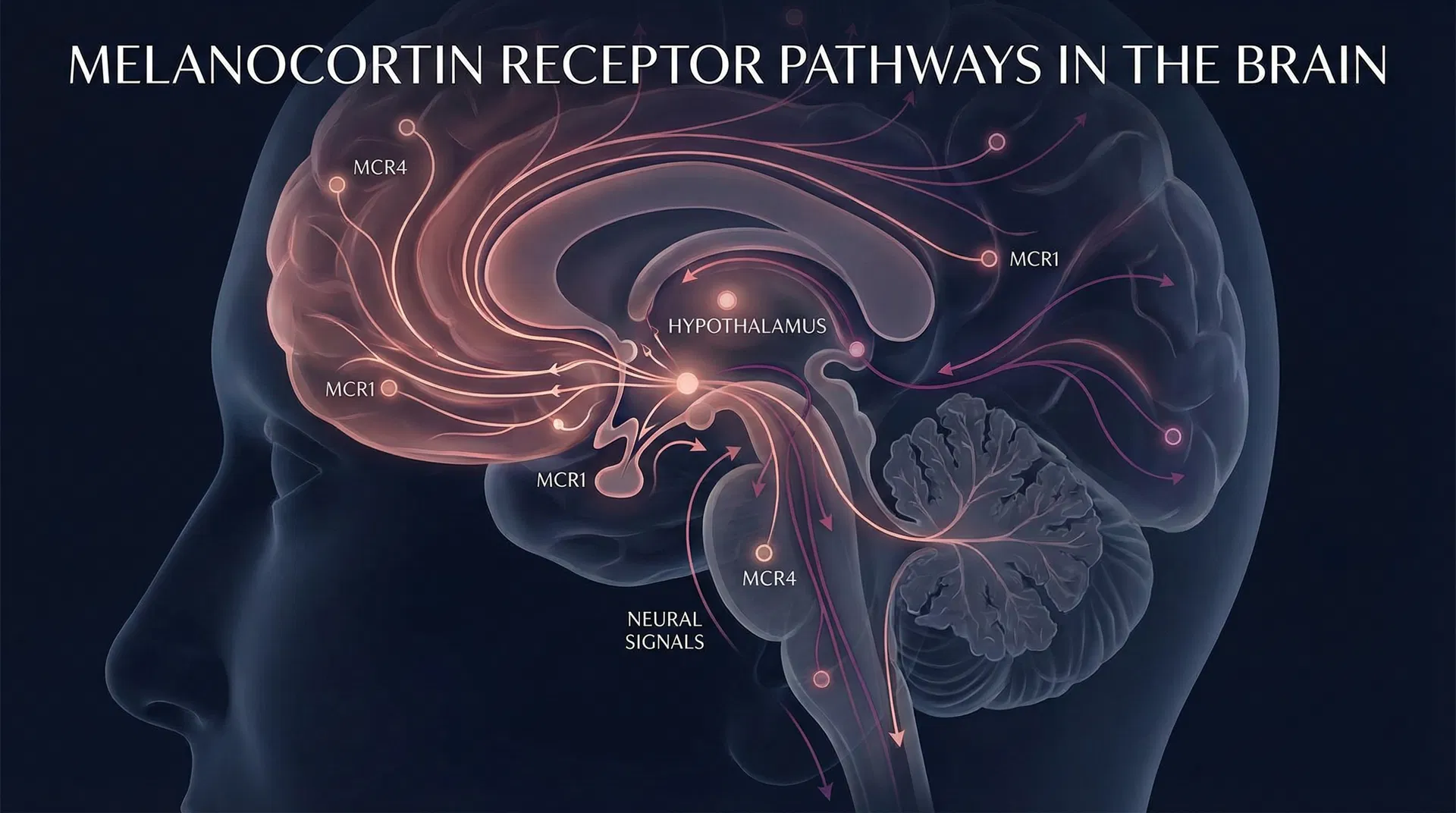
A review in CNS Spectrums delves into the neurobiology of bremelanotide, explaining that its action on melanocortin 4 receptors (MC4R) in the brain's hypothalamus is key to its effects. The authors suggest this activation leads to an increase in dopamine, a neurotransmitter crucial for sexual motivation Pfaus et al., 2022.
Early research also explored the potential of PT-141 [blocked] for male sexual dysfunction. A 2004 study published in the International Journal of Impotence Research evaluated PT-141 in men with erectile dysfunction (ED). The study found that intranasally administered PT-141 was effective in inducing erections in men with ED who did not respond to sildenafil (Viagra) and was generally well-tolerated Diamond et al., 2004.
Another study in The Journal of Sexual Medicine investigated the effects of PT-141 on premenopausal women with female sexual arousal disorder (FSAD). The findings indicated that PT-141 enhanced sexual arousal, particularly in women with FSAD who had normal hormonal levels Safarinejad et al., 2010.
Benefits
The primary research-supported benefit of bremelanotide is its ability to address hypoactive sexual desire disorder (HSDD) in premenopausal women. Studies have consistently shown that it can:
- Increase Sexual Desire: Clinical trials have demonstrated a statistically significant increase in the desire domain of the Female Sexual Function Index (FSFI) for women treated with bremelanotide compared to placebo Kingsberg et al., 2019.
- Reduce Distress: Beyond just improving desire, bremelanotide has also been shown to decrease the personal distress that women experience as a result of low sexual desire, which is a key component of an HSDD diagnosis.
- Potential for Male Sexual Function: While not its primary approved use, early research indicated that PT-141 could be effective in treating erectile dysfunction, even in men who do not respond to PDE5 inhibitors like sildenafil Diamond et al., 2004. It is thought to work via a different mechanism than traditional ED drugs, making it a potential alternative or complementary therapy.
Need help building the right stack? The clinical team at Telegenix designs personalized peptide and hormone protocols based on your labs, goals, and medical history. Schedule a free consultation.
Risks & Side Effects
Bremelanotide is generally considered to have a favorable safety profile, but it is associated with several potential side effects. The most commonly reported adverse events in clinical trials include:
- Nausea: This is the most frequent side effect, often mild to moderate in intensity.
- Flushing: A temporary reddening of the skin.
- Headache: A common side effect of many medications.
It is important to note that bremelanotide can also cause a temporary increase in blood pressure and a decrease in heart rate. For this reason, it is contraindicated in individuals with uncontrolled hypertension or known cardiovascular disease. As with any medication, it is crucial to discuss your medical history with a healthcare provider before considering treatment.
Practical Considerations
Bremelanotide is administered as a subcutaneous injection, typically in the abdomen or thigh, on an as-needed basis before sexual activity. The recommended dosage and timing can vary, and it is essential to follow the guidance of a qualified healthcare professional. The medication is not intended for daily use. The effects of bremelanotide are usually felt within a few hours of administration and can last for several hours.
The Bottom Line
Bremelanotide (PT-141) represents a novel approach to treating sexual dysfunction, particularly HSDD in premenopausal women. Its unique mechanism of action, which targets the central nervous system, sets it apart from many other treatments. While research has established its efficacy and a generally favorable safety profile, it is not without its risks and side effects. As with any medical treatment, a thorough consultation with a healthcare provider is necessary to determine if bremelanotide is an appropriate option.
This information is for educational purposes only. Always consult a licensed healthcare provider before starting any peptide or hormone therapy protocol.
Ready to put this research into practice? Telegenix provides evidence-based peptide and TRT [blocked] protocols supervised by licensed providers. Get a personalized plan built around your bloodwork. Start with a free consultation.
Related Reading
Explore more in-depth guides on related topics:
- PT-141 (Bremelanotide): The Complete Guide to the FDA-Approved Sexual Health Peptide [blocked]
- PT-141 Bremelanotide: What the Science Actually Says — A PubMed-Backed Review [blocked]
- Epithalon: The Anti-Aging Peptide That Activates Telomerase [blocked]
- Dihexa: The Peptide for Cognitive Enhancement and Brain Repair [blocked]
- Semax: The Nootropic Peptide for Brain Health & Recovery [blocked]
For a comprehensive overview, see our Complete Guide to Peptide Therapy [blocked].
Related Comparison: PT-141 vs Cialis: Sexual Health Comparison [blocked]