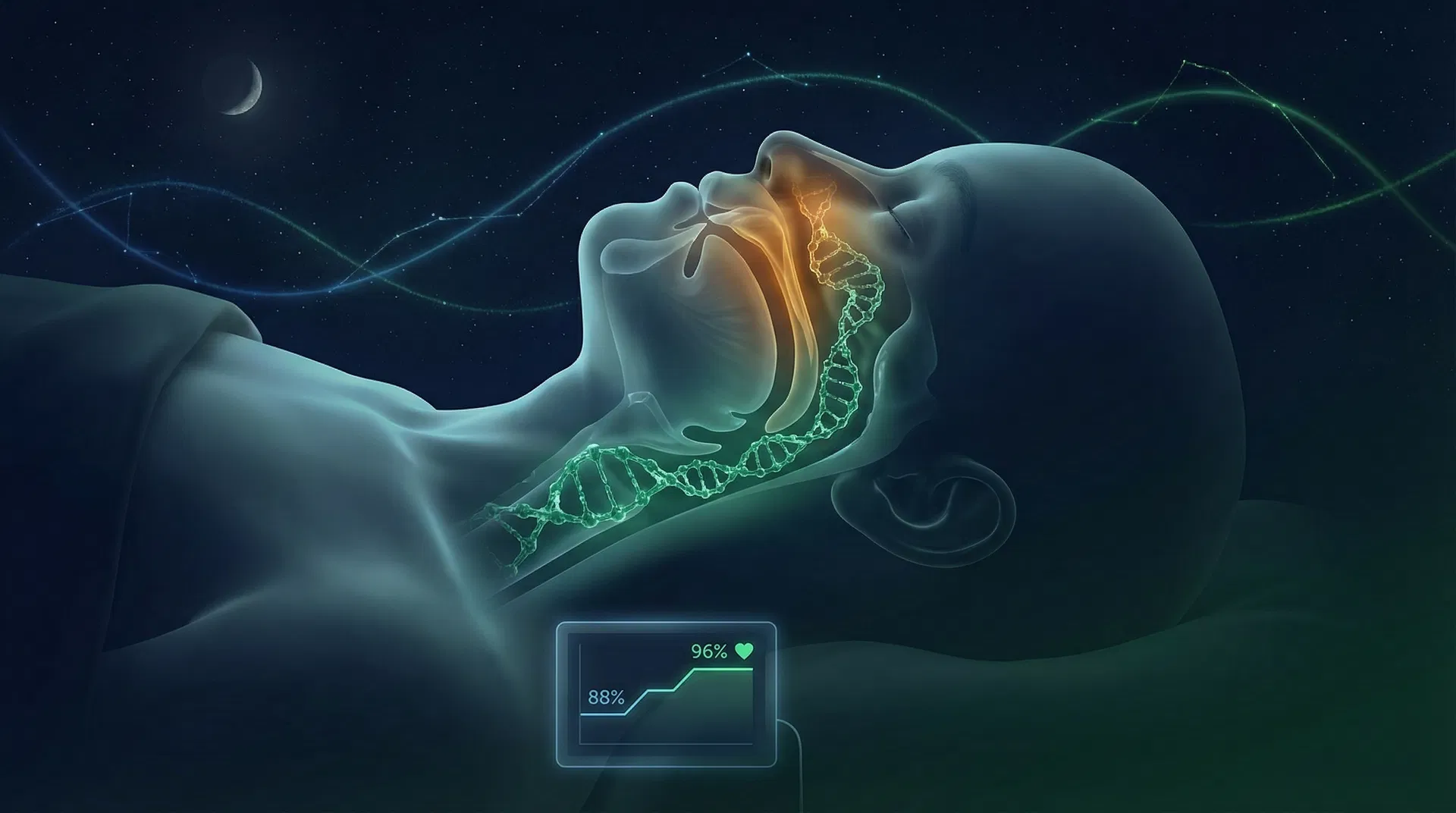
SURMOUNT-OSA: A New Approach to Sleep Apnea
Obstructive sleep apnea (OSA) affects an estimated 936 million adults worldwide, with obesity being the strongest modifiable risk factor. The current standard of care — continuous positive airway pressure (CPAP) — is effective but plagued by poor adherence, with up to 50% of patients unable to tolerate it long-term. The SURMOUNT-OSA trial demonstrated that tirzepatide could dramatically reduce sleep apnea severity through weight loss, potentially offering a pharmacological alternative [1]. For a deeper dive into this area, see testosterone's impact on sleep quality.
Understanding Obesity-Related Sleep Apnea
OSA occurs when excess tissue in the upper airway collapses during sleep, causing repeated breathing interruptions (apneas and hypopneas). The connection to obesity is direct:
- Fat deposition: Excess fat around the neck, tongue, and pharynx narrows the airway
- Abdominal obesity: Reduces lung volume and increases airway collapsibility
- Inflammation: Obesity-related inflammation contributes to upper airway edema
- Dose-response: Each 10% weight gain increases OSA risk by 6-fold
Weight loss of 10-15% has been shown to significantly improve OSA, making potent weight loss medications a logical treatment approach [2].
Considering adding this to your protocol? Telegenix provides physician-supervised peptide and hormone optimization programs tailored to your bloodwork and goals. Schedule your consultation.
Study Design
SURMOUNT-OSA consisted of two parallel studies:
Study 1: Adults with moderate-to-severe OSA and obesity who were not using CPAP Study 2: Adults with moderate-to-severe OSA and obesity who were using CPAP
Both studies shared key design features:
- Randomized, double-blind, placebo-controlled
- 52-week treatment duration
- Tirzepatide escalated to maximum tolerated dose (10 or 15 mg)
- Primary endpoint: Change in apnea-hypopnea index (AHI) from baseline
Key Inclusion Criteria:
- Age 18-65 years
- BMI ≥30 kg/m²
- Moderate-to-severe OSA (AHI ≥15 events/hour)
- Baseline AHI: approximately 50-55 events/hour (severe range) [1]
Primary Results: AHI Reduction
The results were dramatic across both studies:
Study 1 (No CPAP):
- Tirzepatide: AHI reduced by approximately 55-63% (~30 fewer events/hour)
- Placebo: AHI reduced by approximately 6%
- Treatment difference: Highly significant (P<0.001)
Study 2 (With CPAP):
- Tirzepatide: AHI reduced by approximately 43-53%
- Placebo: AHI reduced by approximately 8%
- Treatment difference: Highly significant (P<0.001)
Clinical Severity Reclassification:
- Many patients moved from severe to mild or even normal AHI categories
- A substantial proportion achieved AHI <5 events/hour (considered resolved OSA)
- Some patients in Study 2 were able to reduce or discontinue CPAP use [1]
Weight Loss Results
Weight loss was consistent with other SURMOUNT trials:
- Mean weight loss: Approximately 18-20% in Study 1, 16-18% in Study 2
- Waist circumference: Significant reduction
- Neck circumference: Reduced, directly relevant to airway patency
- BMI reduction: Many patients moved from obese to overweight categories
Beyond AHI: Comprehensive Sleep Improvements
Tirzepatide improved multiple sleep parameters:
- Oxygen desaturation index: Significantly reduced
- Time spent below 90% oxygen saturation: Decreased
- Sleep quality scores: Improved on validated questionnaires
- Daytime sleepiness (Epworth Sleepiness Scale): Significantly reduced
- Patient-reported outcomes: Better sleep quality, less fatigue, improved daytime functioning
Cardiometabolic Benefits
The secondary cardiometabolic outcomes (published by Malhotra et al. in Nature Medicine, 2026) showed:
- Blood pressure: Significant reductions in both systolic and diastolic BP
- CRP: Reduced, indicating decreased systemic inflammation
- HbA1c: Improved in patients with pre-diabetes
- Lipid profile: Improved triglycerides and HDL cholesterol
- Cardiac biomarkers: Reduced NT-proBNP, suggesting decreased cardiac stress [3]
These findings suggest that treating OSA with tirzepatide provides benefits beyond sleep improvement, addressing the cardiovascular risk that makes OSA so dangerous.
CPAP vs. Tirzepatide: A New Paradigm?
The results raise important questions about OSA treatment:
| Factor | CPAP | Tirzepatide |
|---|---|---|
| AHI reduction | 70-90% | 55-63% |
| Adherence | 50-60% long-term | Expected higher (weekly injection) |
| Weight effect | None | 18-20% loss |
| CV risk reduction | Modest | Significant |
| Quality of life | Improves if used | Improves broadly |
| Cost | Device + supplies | Medication cost |
While CPAP produces greater AHI reduction when used consistently, tirzepatide offers a more comprehensive approach by addressing the root cause (obesity) while also improving cardiometabolic health [1].
Clinical Implications
- New treatment option: Tirzepatide offers a pharmacological approach for patients who cannot tolerate CPAP
- Combination therapy: Using tirzepatide alongside CPAP may provide additive benefits
- Root cause treatment: Unlike CPAP, tirzepatide addresses the underlying obesity driving OSA
- Screening opportunity: OSA screening should be routine in patients starting tirzepatide for obesity
- Potential FDA indication: These data support a potential FDA approval for tirzepatide in OSA
Related Comparison: [Ozempic vs Mounjaro: Complete Comparison](/compare/ozempic-vs-mounjaro)
References
-
Malhotra A, Grunstein R, Engström J, et al. "Tirzepatide for the Treatment of Obstructive Sleep Apnea and Obesity." New England Journal of Medicine. 2024. Presented at ADA 2024.
-
Peppard PE, Young T, Barnet JH, et al. "Increased prevalence of sleep-disordered breathing in adults." American Journal of Epidemiology. 2013;177(9):1006-1014. PubMed: 23589584
-
Malhotra A, Grunstein R, Azarbarzin A, et al. "Tirzepatide on obstructive sleep apnea-related cardiometabolic risk: secondary outcomes of the SURMOUNT-OSA randomized trial." Nature Medicine. 2026. PubMed: Available
Ready to put this research into practice? Telegenix provides evidence-based peptide and TRT protocols supervised by licensed providers. Get a personalized plan built around your bloodwork. Start with a free consultation.
Related Reading
Explore more in-depth guides on related topics:
- SURMOUNT-1 Trial: Tirzepatide Achieves Up to 22.5% Weight Loss in Adults Without Diabetes
- SURMOUNT-2 Trial: Tirzepatide Delivers 15.7% Weight Loss in Adults With Obesity and Diabetes
- SURMOUNT-4 Trial: What Happens When You Stop Tirzepatide — The Weight Regain Data
- SUMMIT Trial: Tirzepatide Reduces Heart Failure Risk in Obese Patients With HFpEF
- [STEP 1 Trial: How Semaglutide 2.4mg Achieved 15% Weight Loss in Adults](/library/semaglutide-step-1-trial-weight-loss-results)
For a comprehensive overview, see our Complete Guide to Peptide Therapy.