For many men, the decision to embark on Testosterone Replacement Therapy (TRT) is a significant one, often driven by the desire to alleviate symptoms of low testosterone and improve overall quality of life. However, for men under the age of 45, especially those who still desire to father children, the potential impact of TRT on fertility is often the primary concern. The good news is that modern medical protocols and advancements in hormone therapy have made it increasingly possible to optimize testosterone levels [blocked] while simultaneously preserving spermatogenesis. This comprehensive guide will delve into the mechanisms by which TRT affects fertility and explore the specific pharmaceutical strategies – including HCG, Enclomiphene, Gonadorelin and GnRH analogs [blocked], and FSH – that can help men maintain their reproductive options.
How TRT Suppresses Fertility
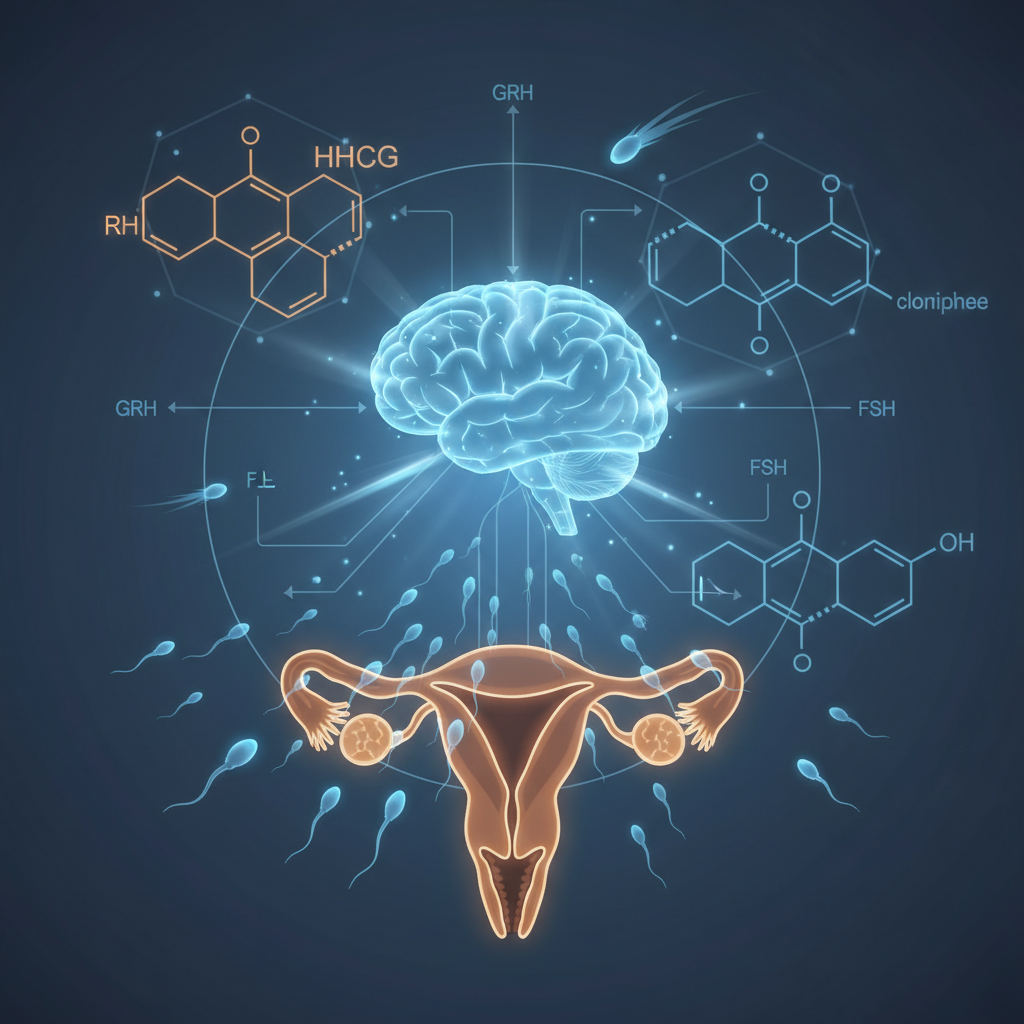
To understand how to preserve fertility during TRT, it's crucial to first grasp how exogenous testosterone impacts the body's natural reproductive axis. The male reproductive system is governed by a delicate feedback loop known as the Hypothalamic-Pituitary-Gonadal (HPG) axis.
- Hypothalamus: The process begins in the hypothalamus, a region of the brain that releases Gonadotropin-Releasing Hormone (GnRH) in a pulsatile manner.
- Pituitary Gland: GnRH then stimulates the pituitary gland to release two critical hormones: Luteinizing Hormone (LH) and Follicle-Stimulating Hormone (FSH).
- Testes:
- LH primarily acts on the Leydig cells in the testes, stimulating them to produce testosterone.
- FSH acts on the Sertoli cells in the testes, which are essential for supporting spermatogenesis (sperm production). FSH is directly responsible for initiating and maintaining sperm maturation.
When exogenous testosterone is introduced into the body (via injections, gels, or pellets), the hypothalamus detects these elevated testosterone levels. This signals to the hypothalamus that the body has sufficient testosterone, leading to a reduction in GnRH pulsatility. Consequently, the pituitary gland reduces its output of LH and FSH.
The suppression of LH leads to a decrease in endogenous testosterone production by the Leydig cells. More critically for fertility, the suppression of FSH directly impairs the Sertoli cells' ability to support spermatogenesis. While the exogenous testosterone circulates throughout the body, the intratesticular testosterone (ITT), which is essential for sperm production, plummets. ITT levels are typically 50-100 times higher than circulating serum testosterone, and this high local concentration is crucial for proper spermatogenesis.
The timeline for fertility suppression can vary, but generally:
- Sperm count begins to drop within 2-3 months of initiating TRT.
- Azoospermia (complete absence of sperm in semen) is possible within 6 months for a significant percentage of men on TRT without co-administration of fertility-preserving agents.
- Oligozoospermia (low sperm count) is common.
This suppression is the primary reason why TRT is often considered a male contraceptive if fertility preservation strategies are not employed.
Recovery After Stopping TRT
For men who discontinue TRT with the goal of restoring fertility, the HPG axis typically reactivates. However, the recovery process is not always immediate or guaranteed, especially after prolonged periods of testosterone administration.
Several studies have investigated the recovery of spermatogenesis after TRT cessation. A notable study by Patel et al. (2020) published in Fertility & Sterility examined outcomes in men who discontinued TRT to pursue fertility. Their findings indicated:****
- Approximately 67% of men recovered to a sperm concentration of >1.5 million/mL within 6 months after stopping TRT.
- 90% recovered within 12 months.
- 100% of the cohort eventually recovered within 24 months to a sperm concentration above the threshold for severe oligozoospermia (though not necessarily to pre-TRT levels or optimal fertility).
While these statistics are generally reassuring, it's crucial to understand that:
- Recovery is not guaranteed for every individual. Factors such as age, duration of TRT, dosage, and pre-existing fertility issues can influence recovery time and success.
- Prolonged TRT use (e.g., several years) may lead to a longer recovery period or, in rare cases, irreversible azoospermia. The exact mechanisms for this are not fully understood but may involve Leydig cell atrophy or damage to the seminiferous tubules.
- Even with recovery of sperm count, sperm quality (motility, morphology) may still be suboptimal for a period.
Given these uncertainties, proactive fertility preservation strategies are highly recommended for any man on TRT who wishes to maintain his reproductive options.
HCG (Human Chorionic Gonadotropin): The Gold Standard
Historically, Human Chorionic Gonadotropin (HCG) has been the cornerstone of fertility preservation protocols for men on TRT.
Mechanism: HCG is a glycoprotein hormone that shares structural and functional similarities with LH. When administered, HCG acts directly on the Leydig cells in the testes, mimicking the action of LH. This direct stimulation prompts the Leydig cells to produce endogenous testosterone, thereby maintaining intratesticular testosterone (ITT) levels. By keeping ITT levels high, HCG helps to prevent the testicular atrophy and suppression of spermatogenesis that would otherwise occur with exogenous testosterone alone. It essentially "tricks" the testes into continuing their function despite the suppressed pituitary LH.
Typical Protocol: A common protocol involves administering HCG alongside TRT. Dosing typically ranges from 500 to 1000 IU, administered 2-3 times per week. The specific dose and frequency can be individualized based on a patient's response, serum testosterone levels, and fertility goals. HCG is usually injected subcutaneously.
Clinical Evidence for Maintaining Spermatogenesis: Numerous studies and clinical experience support the efficacy of HCG in preserving fertility during TRT.
- A review of the literature indicates that co-administration of HCG with TRT can prevent or reverse testicular atrophy and maintain sperm production in a significant number of men [PMID: 23674621].
- Studies have shown that men receiving HCG alongside testosterone therapy maintain significantly higher sperm counts compared to those receiving testosterone alone [PMID: 23674621].
- The Endocrine Society's Clinical Practice Guidelines for Testosterone Therapy acknowledge the utility of HCG for fertility preservation in men undergoing TRT.
The 2020 FDA Compounding Restrictions and Current Availability: In late 2020, the U.S. Food and Drug Administration (FDA) issued guidance regarding the compounding of HCG, stating that it should no longer be compounded from bulk drug substances. This decision significantly impacted the availability of compounded HCG for off-label uses, including fertility preservation during TRT. While FDA-approved HCG products still exist (primarily for female fertility treatments and prepubertal cryptorchidism), their off-label use for male TRT fertility preservation became more challenging and, in some cases, more expensive due to the need for specific prescriptions and sourcing. This regulatory shift has prompted a greater exploration and utilization of alternative fertility-preserving agents like Enclomiphene and Gonadorelin. Patients should consult with their prescribing physician regarding the current availability and legal status of HCG for this indication in their region.
Internal Link: HCG fertility during TRT [blocked] Internal Link: TRT vs HCG [blocked]
Enclomiphene: The Emerging Alternative
Enclomiphene is gaining significant traction as a viable and often preferred alternative for fertility preservation during TRT, particularly in light of HCG's regulatory challenges.
Mechanism: Enclomiphene is a selective estrogen receptor modulator (SERM). Unlike HCG, which acts directly on the testes, Enclomiphene works higher up in the HPG axis. It functions by blocking estrogen receptors in the hypothalamus and pituitary gland. When these receptors are blocked, the hypothalamus perceives lower estrogen levels, leading to an increase in GnRH pulsatility. This, in turn, stimulates the pituitary gland to release more LH and FSH. The increased LH and FSH then act on the testes to stimulate endogenous testosterone production and maintain spermatogenesis, respectively.
Advantages over clomiphene [blocked] (Clomid [blocked]): Enclomiphene is one of the two stereoisomers of clomiphene citrate (Clomid), the other being zuclomiphene.
- Clomiphene citrate is a racemic mixture containing both enclomiphene and zuclomiphene.
- Zuclomiphene has a much longer half-life and is associated with estrogenic TRT side effects [blocked] (e.g., mood swings, visual disturbances) and can accumulate in the body.
- Enclomiphene is the active isomer responsible for stimulating gonadotropin release, has a shorter half-life, and is generally associated with fewer side effects, as it lacks the estrogenic activity of zuclomiphene. This makes Enclomiphene a cleaner and often better-tolerated option for long-term use.
Clinical Trial Data Showing Maintained Sperm Parameters: Clinical trials have demonstrated Enclomiphene's efficacy in maintaining sperm parameters while increasing endogenous testosterone.
- Studies have shown that Encl